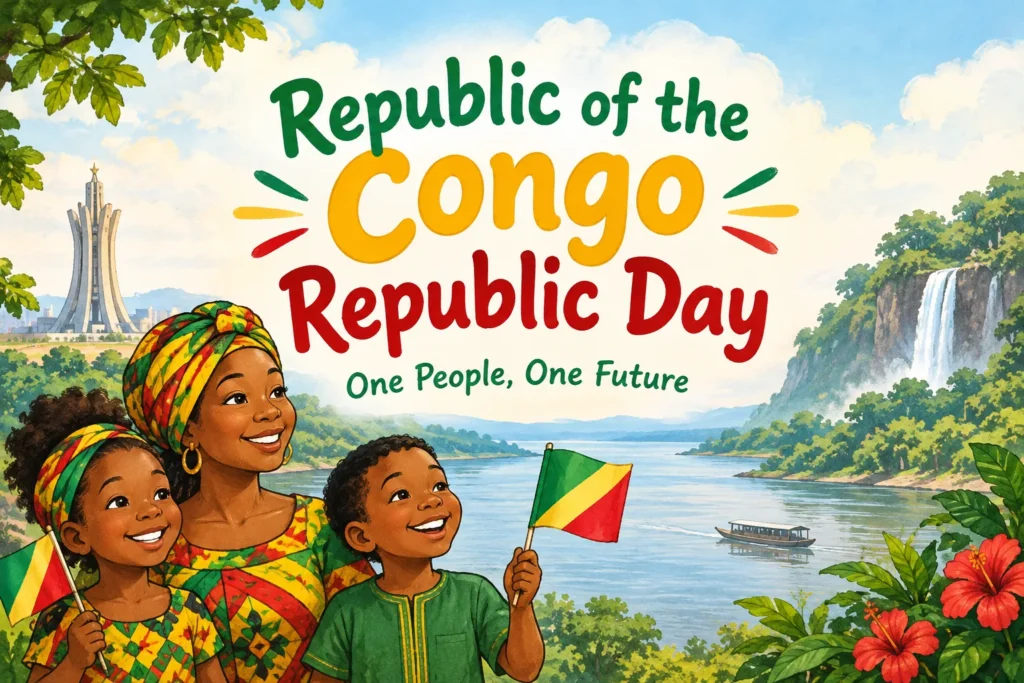
Republic of the Congo Republic Day
Republic of the Congo Republic Day is observed each year on November 28. The national day marks the country’s move toward self-government in 1958, when it became the Republic of the Congo within the French Community. It’s a time to reflect on the country’s history, culture and national identity.
How Republic Day began
The date is tied to a major change in the Congo’s political status under French rule. On November 28, 1958, voters in the territory approved a new constitution in a referendum, and the former French colony became an autonomous republic within the French Community. Full independence followed on August 15, 1960.
Republic Day commemorates that 1958 transition. It is distinct from Independence Day, which is observed in August. The two dates mark separate steps in the country’s path from colonial rule to an independent state.
What the day represents
The Republic of the Congo is in Central Africa, with Brazzaville as its capital. It shares a border with the Democratic Republic of the Congo, whose capital, Kinshasa, lies across the Congo River. The neighboring countries have similar names, but they are separate nations, each with its own government and national observances.
Republic Day connects public life with the country’s history and shared identity. National observances may include official ceremonies, speeches, cultural performances and community gatherings. The exact program can vary by year and location. The day also offers a chance to learn about Congolese traditions, languages and arts, which reflect the country’s many communities and regional influences.
French is the official language of the Republic of the Congo. Lingala and Kituba are also widely used, alongside other languages spoken across the country. Music and dance are important parts of cultural life, though customs and styles differ from one community to another.
Ways to observe Republic Day
-
Learn the difference between Republic Day and Independence Day. November 28 marks the 1958 establishment of the republic; August 15 marks independence in 1960.
-
Find the Republic of the Congo on a map. Locate Brazzaville and the Congo River, then notice Kinshasa on the opposite bank.
-
Explore Congolese music, literature or visual art through a library, museum collection or reputable cultural resource. Look for information about the artist or tradition as you listen or read.
-
Prepare a dish inspired by Congolese cooking using a trusted recipe. Ingredients and cooking traditions vary, so choose a recipe that explains its regional or family background.
-
If you’re attending a local Republic Day event, check its schedule and customs in advance. A cultural program or community gathering can be a thoughtful way to learn and take part.
Last updated November 22, 2026.
When is Republic of the Congo Republic Day?
Republic of the Congo Republic Day: Every year on November 28.
| Year | Date | Day of the week |
|---|---|---|
| 2026 | November 28 | Saturday |
| 2027 | November 28 | Sunday |
| 2028 | November 28 | Tuesday |
| 2029 | November 28 | Wednesday |
| 2030 | November 28 | Thursday |
📄 Free printable 2027 holiday calendar · 📅 Every holiday in 2027, month by month
Frequently asked questions
When is Republic of the Congo Republic Day in 2026?
Republic of the Congo Republic Day is on Saturday, November 28, 2026. After that, it falls on Sunday, November 28, 2027. Every year on November 28.
Is Republic of the Congo Republic Day a public holiday?
No. Republic of the Congo Republic Day is an observance, not an official public holiday, so schools and businesses stay open as usual.
What does Republic of the Congo Republic Day commemorate?
It commemorates the country becoming an autonomous republic within the French Community on November 28, 1958. The change followed a referendum approving a new constitution.
How is Republic Day different from Independence Day in the Republic of the Congo?
Republic Day marks the 1958 transition to an autonomous republic, while Independence Day on August 15 commemorates independence in 1960.
How can people observe Republic of the Congo Republic Day?
People can attend a local ceremony or cultural gathering, or learn about Congolese music, literature, visual art and cooking. Event schedules and customs can vary by year and location.