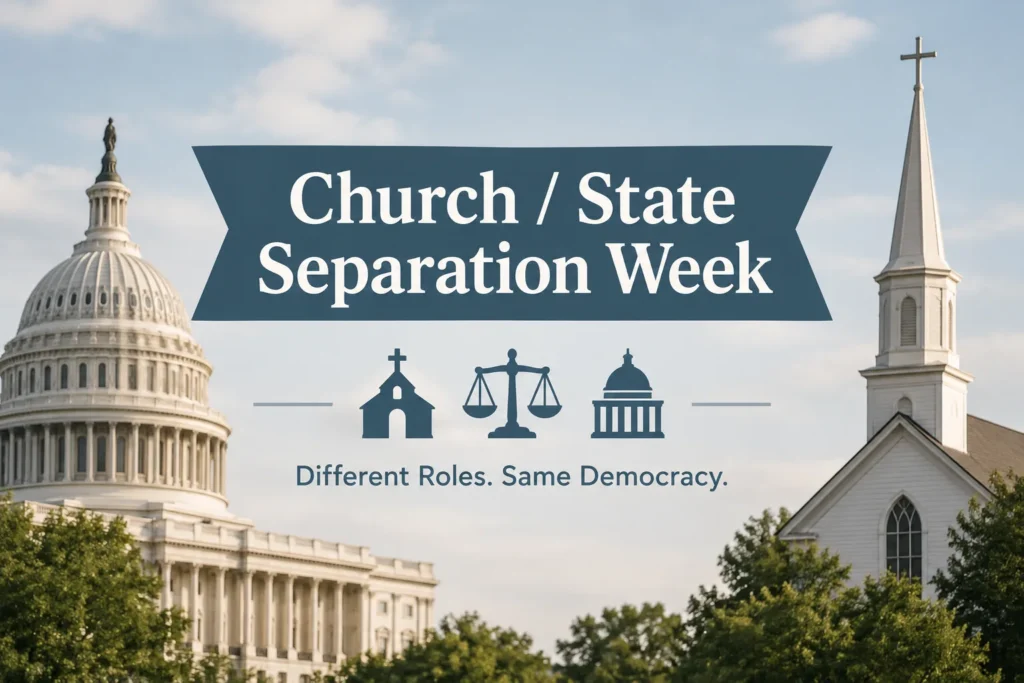
Church / State Separation Week
Church / State Separation Week is observed on November 22. It focuses on the principle that government and religious institutions should remain separate, while people remain free to hold, practice or decline religious beliefs. The observance invites people to learn about how that principle works in public life and why it matters to people with different beliefs.
How the day started
The exact origin of Church / State Separation Week is not well documented. The name is used for an observance centered on the relationship between religion and government, rather than a widely established holiday with a clearly recorded founder or starting year. Its November 22 date also falls near Thanksgiving in the United States, a season when public discussions about faith, civic life and national traditions often come into view.
The subject has a long history in American public debate. The First Amendment to the U.S. Constitution, ratified in 1791, says Congress may not establish a religion or prohibit the free exercise of religion. These protections are commonly described through two related ideas: government should not favor or establish a religion, and people should be able to practice their faith freely, within the law.
What separation means
“Separation of church and state” is a familiar phrase, but it doesn’t appear in the text of the First Amendment. The phrase is often used to describe how the amendment’s religion clauses guide the relationship between government and religious life. In practice, questions about that relationship can arise in schools, public services, government ceremonies and other shared spaces.
The principle doesn’t require people to leave their beliefs at home. Individuals and religious communities can take part in public life, speak about their views and gather for worship. At the same time, government bodies must follow constitutional rules and cannot make religious practice a condition of citizenship or public participation. How these rules apply in a specific situation may depend on the facts and legal decisions involved.
People may disagree about where the boundaries should be. Some see a firm separation as protection for religious freedom, including the freedom not to follow a religion. Others focus on the place religious expression can have in civic life. Learning the basic principles can make these conversations clearer and more respectful.
Ways to observe Church / State Separation Week
- Read the First Amendment, then look up a plain-language explanation of its religion clauses. Notice the difference between protecting religious practice and government endorsement of a religion.
- Discuss the topic with family or friends. Try using a real-life question, such as how a public school can accommodate students’ beliefs while treating them fairly.
- Visit a library or museum exhibit about the Constitution, religious history or civic life. A local perspective can make a broad principle easier to understand.
- Listen to people whose beliefs differ from yours. Ask how they understand religious freedom, and make room for the freedom to believe, change beliefs or have none.
- For a classroom or community group, compare a few examples of government and religion interacting. Separate what the Constitution says from personal opinions about what a policy should be.
When is Church / State Separation Week?
Church / State Separation Week: Every year on the fourth Sunday of November.
| Year | Date | Day of the week |
|---|---|---|
| 2026 | November 22 – November 28 | Sunday – Saturday |
| 2027 | November 28 – December 4 | Sunday – Saturday |
| 2028 | November 26 – December 2 | Sunday – Saturday |
| 2029 | November 25 – December 1 | Sunday – Saturday |
| 2030 | November 24 – November 30 | Sunday – Saturday |
📄 Free printable 2027 holiday calendar · 📅 Every holiday in 2027, month by month
Reviewed by the Holiday Day List editorial team on November 12, 2026 · Last updated November 17, 2026.
Frequently asked questions
When is Church / State Separation Week in 2026?
Church / State Separation Week is on Sunday, November 22, 2026. After that, it falls on Sunday, November 28, 2027. Every year on the fourth Sunday of November.
Is Church / State Separation Week a public holiday?
No. Church / State Separation Week is an observance, not an official public holiday, so schools and businesses stay open as usual.
What does Church / State Separation Week mean?
It focuses on the principle that government and religious institutions should remain separate while people remain free to practice a religion, change beliefs or have none. The First Amendment protects religious practice and bars Congress from establishing a religion.
How did Church / State Separation Week start?
The exact origin of Church / State Separation Week isn't well documented. There’s no clearly recorded founder or starting year.
How can people observe Church / State Separation Week?
Read the First Amendment and learn about its religion clauses. You can also discuss real-life questions about religion in public life, visit a library or museum exhibit, or listen to people with different beliefs.