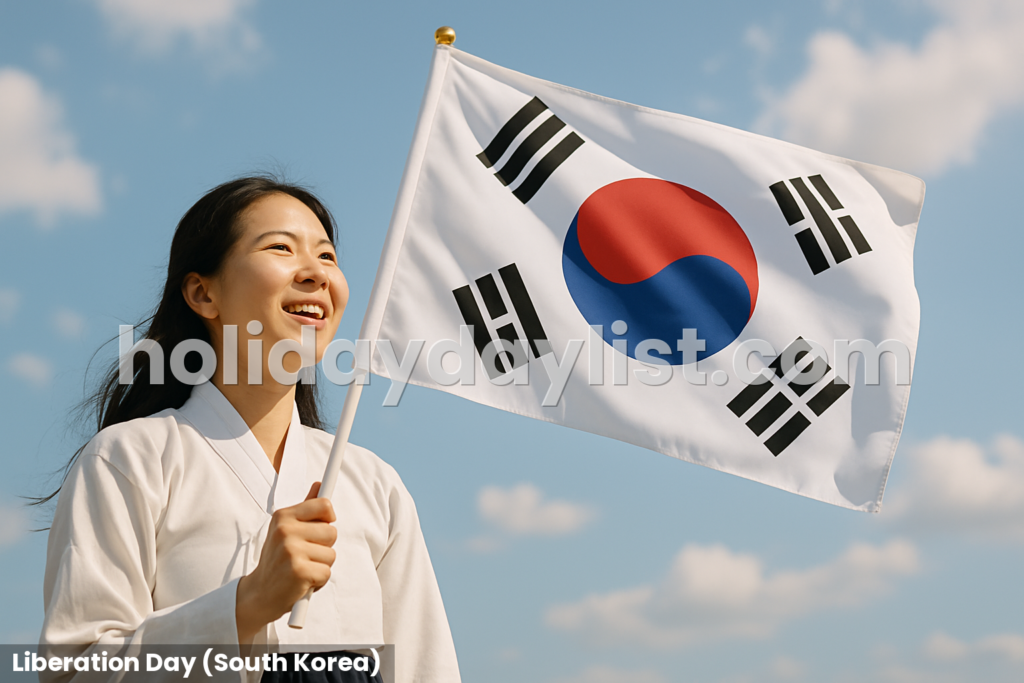
Liberation Day (South Korea)
What Is Liberation Day in South Korea?
On August 15, South Korea celebrates Liberation Day, known in Korean as Gwangbokjeol. The name is often translated as “Restoration of Light,” a fitting phrase for a day that looks back on the end of a difficult era and the return of Korean independence. It is one of South Korea’s most important national holidays, marked by ceremonies, flags, and time with family.
The date commemorates Korea’s liberation from Japanese colonial rule in 1945, at the end of World War II. Korea had been under Japanese rule since 1910, and the period brought significant hardship and restrictions on Korean life, culture, and political freedom. August 15 is remembered as a turning point—the day liberation was announced and hope for a self-governing future returned.
A Day of Remembrance and Renewal
Liberation Day is both celebratory and reflective. It honors the people who worked and struggled for independence, including activists, organizers, and everyday families who preserved Korean identity through a challenging time. The holiday also invites people to consider the value of freedom, cultural heritage, and the sacrifices made by earlier generations.
The date carries another important historical connection: in 1948, the Republic of Korea was formally established on August 15. Liberation Day therefore looks back not only to the end of colonial rule, but also to the beginnings of the modern South Korean state. The events that followed liberation were complex, and the Korean Peninsula became divided. The holiday’s meaning is closely tied to these broader questions of independence, nationhood, and the hope for a peaceful future.
How South Korea Observes the Holiday
Across the country, South Korean flags—called taegeukgi—are displayed on homes, streets, and public buildings. The national flag features a red-and-blue circle at its center, surrounded by four black trigrams. For many people, putting out the flag is a simple way to take part in the day and show respect for the country’s history.
Official commemorative ceremonies are held, including a national ceremony attended by government leaders and invited guests. Speeches, musical performances, and tributes honor those who contributed to Korea’s independence. Museums and historic sites may host special programs, while television and other media often share documentaries, interviews, and stories about the period.
For families, the day may be quieter: a chance to spend time together, visit a cultural or historical site, or talk with younger generations about the past. As Liberation Day is a public holiday, many people also enjoy a day away from work or school. The ways people observe it vary, but remembrance and national pride remain at the heart of the occasion.
Ways to Mark Liberation Day
- Learn a piece of history: Read about the independence movement or explore a museum exhibit about Korea’s modern history.
- Display the taegeukgi respectfully: Learn what the flag looks like and how it is traditionally shown on national days.
- Share family stories: Ask relatives what they know about Korea’s history, traditions, or the meaning of the holiday.
- Explore Korean culture: Enjoy Korean music, food, literature, or film as a way to celebrate the culture that endured and flourished.
- Reflect on freedom: Consider what independence and cultural identity mean in your own community.
Liberation Day is a celebration of a nation’s return to independence, but it is also a reminder that freedom and self-determination are precious. Each August 15, South Koreans honor the past while looking toward a future shaped by hope, remembrance, and connection.
When is Liberation Day (South Korea)?
- Sunday, August 15, 2027
- Tuesday, August 15, 2028
- Wednesday, August 15, 2029
Frequently asked questions
When is Liberation Day (South Korea) in 2027?
Liberation Day (South Korea) is on Sunday, August 15, 2027. After that, it falls on Tuesday, August 15, 2028. Every year on August 15.
Is Liberation Day (South Korea) a public holiday?
No. Liberation Day (South Korea) is an observance, not an official public holiday, so schools and businesses stay open as usual.

