Remembrance Day for the Victims of Holodomors
Remembrance Day for the Victims of Holodomors is observed in Ukraine on the fourth Saturday of November. It honors the people who died in the Holodomor and in other famines that struck Ukraine during the Soviet era. In 2026, the observance falls on November 28.
How the day began
Ukraine’s national day of remembrance was established by presidential decree in 1998, initially as the Day of Remembrance for the Victims of the Holodomor. Its name was later expanded to include victims of other famines. The observance centers on the Holodomor of 1932–1933, a famine in Soviet Ukraine that caused the deaths of millions. The exact death toll remains disputed among historians.
The word Holodomor is commonly translated from Ukrainian as “death by hunger” or “killing by hunger.” The famine occurred under Soviet rule, during Joseph Stalin’s leadership. The forced collectivization of agriculture, grain requisitions and restrictions on movement contributed to the catastrophe. Ukraine and many other countries recognize the Holodomor as genocide; the designation is not shared by every government or historian.
Remembering the victims
For many families, remembrance is personal. The famine left lasting grief and silence: speaking openly about it was dangerous under Soviet rule, and records and family stories were often difficult to preserve. Today, memorials, museums, archives and oral histories help people learn about those who died and the lives that were disrupted.
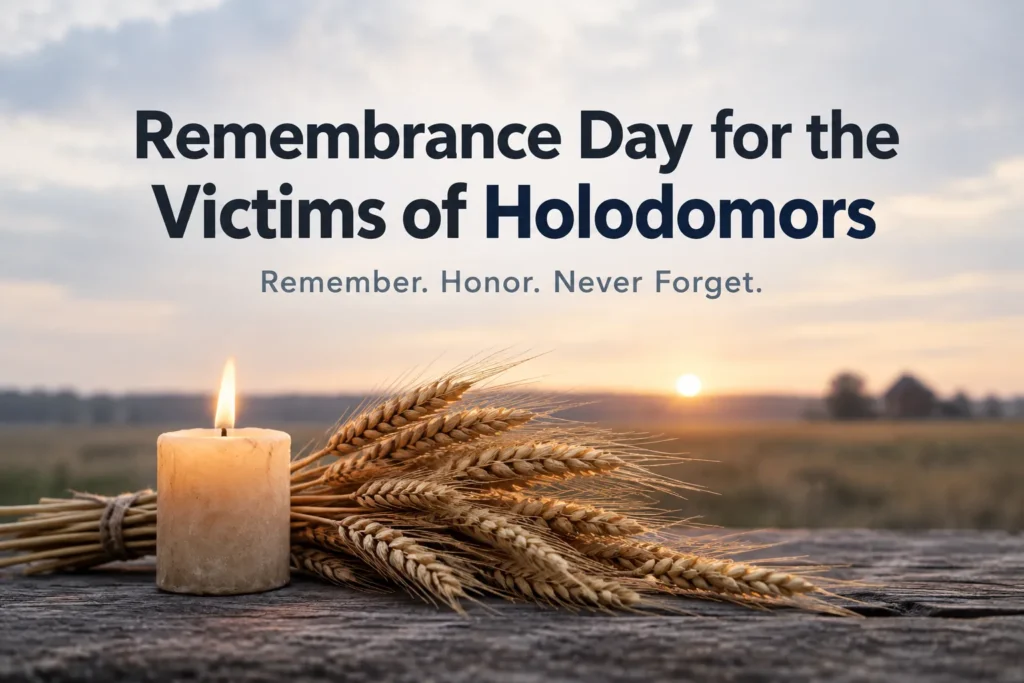
A central symbol of the observance is a lit candle placed in a window. At dusk on the fourth Saturday of November, Ukrainians and supporters in other countries light candles in memory of the victims. The simple gesture makes remembrance visible in homes and communities, while ceremonies and moments of silence offer space for reflection.
The day also encourages careful attention to historical evidence and to the experiences of survivors. Learning about the famine means recognizing both the policies that caused widespread hunger and the human stories behind the history. Family testimony, photographs and documents can help bring those stories into view.
Ways to take part
- Light a candle at dusk and place it safely in a window. If an open flame isn’t suitable, use an electric candle.
- Attend a local memorial service, museum program or community gathering. Ukrainian cultural organizations and churches may share event details.
- Read a firsthand account or explore a museum or archival collection about the Holodomor. Choose sources that distinguish documented facts from disputed interpretations.
- Share a family story or a reliable educational resource with children or friends, taking care to discuss the subject in an age-appropriate, respectful way.
- Visit a memorial or place of remembrance, if one is nearby, and follow any guidance for visitors.
Last updated November 21, 2026.
When is Remembrance Day for the Victims of Holodomors?
Remembrance Day for the Victims of Holodomors: Every year on the fourth Saturday of November.
| Year | Date | Day of the week |
|---|---|---|
| 2026 | November 28 | Saturday |
| 2027 | November 27 | Saturday |
| 2028 | November 25 | Saturday |
| 2029 | November 24 | Saturday |
| 2030 | November 23 | Saturday |
📄 Free printable 2027 holiday calendar · 📅 Every holiday in 2027, month by month
Frequently asked questions
When is Remembrance Day for the Victims of Holodomors in 2026?
Remembrance Day for the Victims of Holodomors is on Saturday, November 28, 2026. After that, it falls on Saturday, November 27, 2027. Every year on the fourth Saturday of November.
Is Remembrance Day for the Victims of Holodomors a public holiday?
No. Remembrance Day for the Victims of Holodomors is an observance, not an official public holiday, so schools and businesses stay open as usual.
What does Remembrance Day for the Victims of Holodomors honor?
It honors people who died in the Holodomor and other famines that struck Ukraine during the Soviet era. The observance centers on the Holodomor of 1932–1933, which caused the deaths of millions.
How did Remembrance Day for the Victims of Holodomors begin?
Ukraine established the national day of remembrance by presidential decree in 1998, initially naming it the Day of Remembrance for the Victims of the Holodomor. The name was later expanded to include victims of other famines.
How can people observe Remembrance Day for the Victims of Holodomors?
At dusk, light a candle and place it safely in a window; an electric candle is an option if an open flame isn't suitable. You can also attend a memorial service, visit a museum or memorial, or learn from firsthand accounts and archival sources.