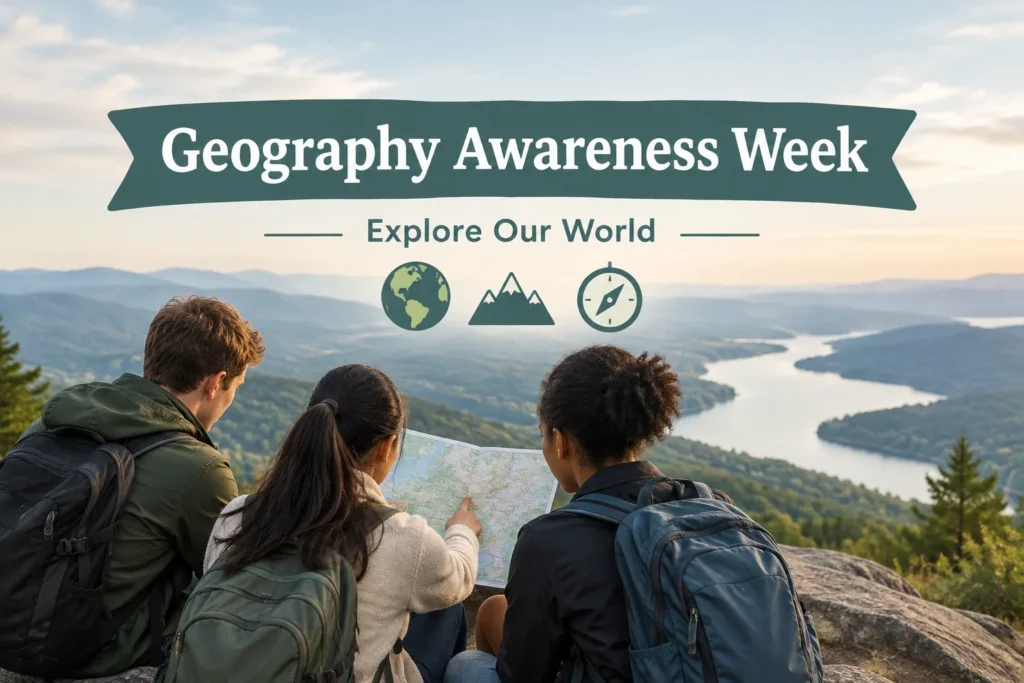
Geography Awareness Week
Geography Awareness Week is observed on November 16, a date set aside to encourage people to learn about geography and the ways it helps us understand the world. The observance can be marked in classrooms, libraries, community groups, or at home, with activities that explore places, maps, landscapes, and the connections between people and their surroundings.
How Geography Awareness Week started
The exact origin of Geography Awareness Week is not well documented, so it’s best not to pin it on a particular founder or starting year. The observance is centered on making geography more visible and approachable. It highlights a subject that includes much more than memorizing country names: geography helps us examine where things are, how places differ, and how people and environments affect one another.
November 16 is the day associated with the observance, though activities may take place throughout the week. Schools and other groups can use the occasion to bring maps and place-based learning into lessons and events.
What geography helps us understand
Geography has two closely connected areas of focus. Physical geography looks at natural features and processes, such as mountains, rivers, coastlines, weather, and climate. Human geography explores people and places, including languages, settlements, migration, trade, and how communities use land and resources.
Maps are one familiar tool, but geography also draws on photographs, satellite images, field observations, and digital mapping. These tools help people notice patterns: where a river flows, how a city has grown, or how roads connect neighborhoods. A map can also influence what we notice, since its scale, labels, and chosen features shape the picture it presents.
Geography is useful in everyday life. It can help someone plan a route, understand a local weather report, follow the journey of a food product, or make sense of news about a place far away. It also encourages thoughtful questions about local surroundings: Where does drinking water come from? How do people travel around town? What changes when a shoreline, forest, or neighborhood develops?
Learning about other places can make the world feel less abstract. It gives context to differences in climate, landscapes, languages, and ways of life, while showing that communities are connected through travel, trade, shared environments, and communication.
Ways to take part
- Choose a map and trace a familiar route, such as the trip to school, work, or a nearby park. Notice landmarks, waterways, and changes in the landscape along the way.
- Explore a digital map of your neighborhood. Compare it with an older map or photograph, if one is available, and look for changes in roads, buildings, or green spaces.
- Pick a place in the news and find it on a map. Look at its neighboring regions, nearby bodies of water, and the routes that connect it to other places.
- Make a simple map of a room, garden, or local walking route. Add a title, labels, and a compass direction, then see whether someone else can use it.
- Ask a family member about a place that matters to them. Find it on a map and learn what the surrounding landscape is like.
- Visit a library or classroom and look for an atlas, globe, or geography activity. A short map-reading session can be a good starting point for a longer conversation about the world.
When is Geography Awareness Week?
Geography Awareness Week: The third full week of November (Monday to Friday), organised by the National Geographic Society; GIS Day falls on its Wednesday.
| Year | Date | Day of the week |
|---|---|---|
| 2026 | November 16 – November 20 | Monday – Friday |
Reviewed by the Holiday List editorial team on November 10, 2026 · Last updated November 11, 2026.
Frequently asked questions
When is Geography Awareness Week in 2026?
Geography Awareness Week is on Monday, November 16, 2026. The third full week of November (Monday to Friday), organised by the National Geographic Society; GIS Day falls on its Wednesday.
Is Geography Awareness Week a public holiday?
No. Geography Awareness Week is an observance, not an official public holiday, so schools and businesses stay open as usual.
What is Geography Awareness Week?
Geography Awareness Week encourages people to learn how geography helps us understand places, landscapes, and the connections between people and their surroundings. It highlights both physical geography, such as rivers and climate, and human geography, such as migration and trade.
How did Geography Awareness Week start?
The exact origin of Geography Awareness Week isn't well documented, so no particular founder or starting year can be confirmed.
How can I take part in Geography Awareness Week?
Trace a familiar route on a map, explore how your neighborhood has changed, or make a simple map of a room or walking route. You can also find a place in the news on a map or look for an atlas or geography activity at a library.
Sources
- National Council for Geographic Education: Geography Awareness Week
- National Geographic: Geography Awareness Week
- U.S. Census Bureau: Geography Awareness Week: November 13-17, 2023
✓ Date verified against National Council for Geographic Education: Geography Awareness Week on November 10, 2026.