Dussehra (Vijayadashami)
Dussehra (Vijayadashami) – October 20, 2026: History, Meaning, and Celebrations
Dussehra, also known as Vijayadashami or Dasara, is an important Hindu festival celebrated in India and by Hindu communities around the world. The festival symbolizes the victory of good over evil and marks the culmination of Navaratri celebrations in many regions.
Dussehra is associated with two major religious traditions. In the Ramayana tradition, it commemorates Lord Rama’s victory over Ravana. In other regions, particularly where Durga Puja is celebrated, Vijayadashami marks Goddess Durga’s victory over the buffalo demon Mahishasura.
The festival is observed through prayers, cultural performances, processions, fairs, and regional customs. Although the underlying theme of victory and renewal is widely shared, the way people celebrate Dussehra varies significantly across India.
When Is Dussehra?
Dussehra follows the Hindu lunar calendar and falls on the tenth day, known as Dashami, of the bright fortnight of the month of Ashwin. Its Gregorian calendar date therefore changes each year, usually falling in September or October.
In 2026, Dussehra is observed on Tuesday, October 20, in most parts of India. Some regional traditions, including Bengal’s Vijayadashami observance, fall on October 21.
- Date in most of India in 2026: October 20
- Also known as: Vijayadashami, Dasara, and Dussehra
- Religion: Hinduism
- Significance: Victory of good over evil
- Related festival: Navaratri and, in many regions, Durga Puja
- Public holiday status: Gazetted holiday in India, with local schedules varying
History and Religious Significance of Dussehra
Dussehra draws its meaning from Hindu religious traditions and stories that have been passed down through generations. Two of the festival’s most prominent associations are Lord Rama’s victory over Ravana and Goddess Durga’s victory over Mahishasura.
Lord Rama’s Victory Over Ravana
According to the Ramayana, Ravana, the king of Lanka, abducted Sita, the wife of Lord Rama. Rama, assisted by Lakshmana, Hanuman, and an army of allies, fought to rescue her.
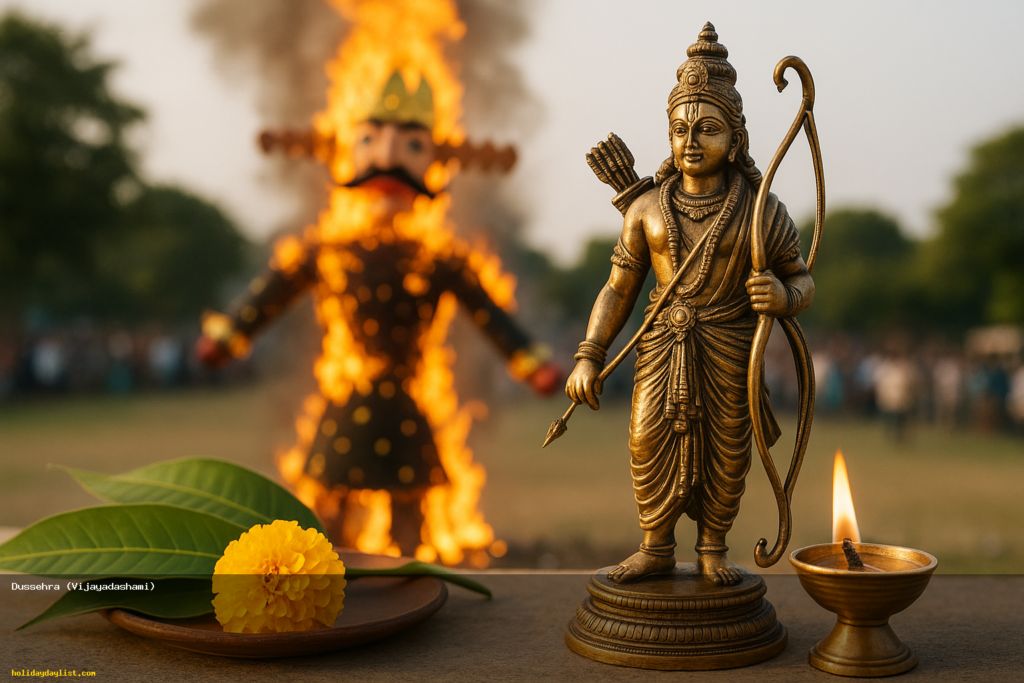
Rama’s victory over Ravana is commemorated during Dussehra in many parts of India. In numerous communities, the occasion includes Ramlila performances that dramatize episodes from the Ramayana. These performances often conclude with Ravan Dahan, the ceremonial burning of effigies representing Ravana and sometimes other figures from the story.
For devotees, this tradition represents the triumph of righteousness over wrongdoing and the importance of courage, responsibility, and moral conduct.
Goddess Durga’s Victory Over Mahishasura
In another major tradition, Vijayadashami marks Goddess Durga’s victory over Mahishasura, a powerful buffalo demon. The story is central to Durga Puja, especially in West Bengal and several eastern Indian communities.
After days of worship and celebration, Vijayadashami brings Durga Puja to a close in many places. Rituals may include prayers, processions, and the immersion of Durga idols in water, symbolizing the goddess’s departure and return to her divine home.
These traditions demonstrate the diversity of Dussehra: the festival can commemorate different stories while expressing a shared theme of the victory of good over evil.
Why Is Dussehra Celebrated?
Dussehra carries religious, cultural, and moral significance. For many Hindus, it is a time to reflect on the importance of righteousness, courage, devotion, and the responsibility to stand against wrongdoing.
The festival also provides an opportunity for communities to preserve traditional performing arts, share stories with younger generations, and gather for worship and cultural events.
In some regions, Dussehra is associated with beginning new activities, honoring tools and work equipment, or seeking blessings for learning and prosperity. These practices vary according to local customs and family traditions.
How Is Dussehra Celebrated?
Dussehra celebrations differ across India, reflecting the country’s diverse religious and cultural traditions.
- Ravan Dahan: In many northern and central Indian communities, large effigies of Ravana are burned during public celebrations to represent Rama’s victory.
- Ramlila performances: Actors and community groups stage episodes from the Ramayana, often culminating in the battle between Rama and Ravana.
- Durga Puja and Vijayadashami: In Bengal and other regions, the final day of Durga Puja includes prayers, farewell rituals, processions, and idol immersion.
- Mysuru Dasara: In Mysuru, Karnataka, the festival is known for its royal heritage, decorated processions, cultural programs, and illumination of Mysore Palace.
- Kullu Dussehra: In Himachal Pradesh, Kullu hosts a distinctive week-long festival that begins after the usual Vijayadashami date and features processions involving local deities.
- Family gatherings and festive meals: Families may visit relatives, share traditional food, attend religious ceremonies, and exchange greetings.
- Worship and prayer: Devotees may visit temples, perform puja at home, and seek blessings for well-being and success.
These examples are not exhaustive. Local traditions, schedules, and ceremonies vary from place to place.
Fun Facts About Dussehra
- It has several names: Dussehra is also called Vijayadashami and Dasara, depending on lang
When is Dussehra (Vijayadashami)?
Dussehra (Vijayadashami): Date changes every year (it follows a lunar or religious calendar).
| Year | Date | Day of the week |
|---|---|---|
| 2027 | October 9 | Saturday |
Reviewed by the Holiday List editorial team on October 19, 2026 · Last updated October 19, 2026.
Frequently asked questions
When is Dussehra (Vijayadashami) in 2027?
Dussehra (Vijayadashami) is on Saturday, October 9, 2027. Date changes every year (it follows a lunar or religious calendar).
Is Dussehra (Vijayadashami) a public holiday?
Yes. Dussehra (Vijayadashami) is an official public holiday where it is observed, so government offices and many schools and businesses may be closed. Closures vary by region and employer.
What does Dussehra celebrate?
Dussehra celebrates the victory of good over evil. In many traditions, it commemorates Rama’s victory over Ravana; in others, Vijayadashami marks Goddess Durga’s victory over Mahishasura.
How do people celebrate Dussehra?
Celebrations include Ramlila performances, burning effigies of Ravana, prayers, processions, fairs, and regional customs. In many places, Vijayadashami concludes Durga Puja with farewell rituals and the immersion of Durga idols.
What is the origin of Dussehra?
Dussehra draws its meaning from Hindu religious traditions associated with Rama’s victory over Ravana and Durga’s victory over Mahishasura. Its exact origin isn't well documented.
Sources
- UNESCO Intangible Cultural Heritage — Ramlila
- Encyclopaedia Britannica — "Dussehra
- Government of India — Incredible India
✓ Date verified against UNESCO Intangible Cultural Heritage — Ramlila on October 19, 2026.